
Ontario Global Adjustment (GA) is a charge applied to electricity bills that covers the difference between the market price of electricity and the actual cost of building, maintaining, and contracting the province’s power generation. For large commercial and industrial energy users, GA can represent a significant share of total electricity costs, often more than the underlying commodity price itself. (See IESO’s overview of Global Adjustment for the regulator’s own explanation.)
Large-scale energy users in Ontario can spend hundreds of thousands of dollars each year on Ontario Global Adjustment charges, often without a clear understanding of what drives these costs or why they change so much from year to year. If you oversee production, energy procurement, or cost management at a commercial or industrial facility, you’ve likely felt this impact directly.
This article breaks down what GA is, how it’s calculated for Class A and Class B customers, why rates have been unusually volatile, and what our analysts expect for GA costs through 2030 and beyond.
What Is Global Adjustment in Ontario?
Ontario’s Independent Electricity System Operator (IESO), the agency that administers the wholesale electricity market and manages grid infrastructure, applies two major components to electricity rates: energy cost and Global Adjustment. How that energy cost is billed depends on the customer.
Residential and small business accounts pay a regulated energy price, either time-of-use or tiered pricing, set by the Ontario Energy Board. Interval-metered medium and large businesses instead pay the Ontario Electricity Market Price (Ontario Price), the actual wholesale price of electricity, as its own line item. GA is layered on top of either pricing structure, and it allows the grid operator to recover capital costs for energy generation: the investments required to build and maintain nuclear, hydro, solar, biomass, and gas generation, and to deliver energy services to the grid. It’s also important to note that electricity prices and GA are inversely related.
Ontario introduced Global Adjustment in 2006, with the Industrial Conservation Initiative (ICI) added in 2011. The ICI was introduced as a demand response program to encourage the province’s largest energy users to curtail their electricity demand during the province’s top 5 coincident peak events – the 5 hours each year where the Ontario grid is at peak demand.
The goal of these programs was to repay major infrastructure investments across the province while promoting demand-side management among large energy users.
GA has created ongoing confusion for customers, particularly in commercial and industrial markets where it contributes significantly to overall electricity costs. The term itself reveals little about what the line item actually represents. It’s also worth noting that GA applies only to large-scale energy users. Homes, farms, and small- to medium-sized businesses generally don’t see it broken out as a separate charge. For these customers, GA is baked directly into standard electricity rates.
Some of this confusion has been compounded by Ontario’s Market Renewal Program (MRP), which went live on May 1, 2025, and represents the most significant overhaul of Ontario’s electricity market since deregulation. MRP was the replacement of the old province-wide Hourly Ontario Energy Price (HOEP) with a nodal pricing system, Locational Marginal Prices (LMPs), and introduced a formal day-ahead market, changes designed to better reflect local congestion and generation costs across the grid.
What MRP did not change is Global Adjustment itself: GA remains a separate charge, layered on top of the new nodal energy pricing, using the same underlying cost-recovery logic described above. In other words, the way Ontario prices energy changed substantially in 2025; the way it recovers generation investment costs through GA did not. If you’re interested in learning more, check out our guide to Market Renewal Program for Class A customers.
Several components make up total GA costs, including new infrastructure built to complement Ontario’s large-scale generating facilities, which include:
- 3 nuclear power plants
- 6 gas generating stations
- 5 hydropower facilities
- 14 transmission-connected solar projects
- 1 large biomass facility
Maintenance and upgrades to existing resources, including recent and ongoing refurbishment work at all three nuclear power plants, also factor into GA. So do the province’s conservation programs, which help commercial and industrial energy users retrofit facilities to reduce consumption.
How Global Adjustment Costs Are Calculated: Class A vs. Class B
Every Ontario electricity customer pays GA, but how that cost is allocated depends on billing classification under the Industrial Conservation Initiative (ICI). Eligibility is tiered by average monthly peak demand:
| Business Type | Class A Eligibility | Notes |
| Manufacturing/industrial (NAICS 31, 32, 33, 1114) | 500 kW – 1 MW | Can opt in as Class A |
| Other medium-sized consumers | >1 MW and <5 MW | Can opt in as Class A |
| Large energy users | >5 MW | Automatically enrolled as Class A; can opt out |
Businesses that qualify but aren’t automatically enrolled must opt in, and large consumers who’d prefer Class B must opt out, by June 15 each year, based on the prior 12-month (May–April) base period.
Class A customers pay their share of GA based on their Peak Demand Factor (PDF): their consumption during Ontario’s five highest system-wide demand hours of the year, divided by the province-wide total consumption across those same five hours. For example, if a facility consumed a combined 20.015 MWh across the year’s top five peak hours, and Ontario’s system-wide consumption across those same five hours totaled 117,875.695 MWh, that facility’s PDF would be roughly 0.00017 (0.017%), and it would be billed that same percentage of the total monthly Class A GA cost pool. The IESO publishes the year’s top five peaks and system-wide totals after the base period closes, so a facility’s exact PDF isn’t confirmed until the following adjustment period begins.
Class B customers, facilities that don’t participate in the ICI, which is most medium-sized businesses, pay GA by multiplying their total monthly consumption (MWh) by the Class B GA rate published on the IESO website for that month. The IESO actually publishes three variations of this rate each month (a 1st estimate, a 2nd estimate, and a final actual rate) to accommodate different utility billing cycles. If the rate on your bill doesn’t match the rate published on IESO’s website, that’s usually why. Your utility can confirm which variation they use.
This distinction creates very different incentives. Class A customers are effectively rewarded for reducing consumption during anticipated system peak hours, a strategy commonly known as peak shaving. Class B customers are billed on total usage regardless of timing, so they have comparatively little incentive to manage when they consume electricity.
It’s worth understanding the timing here, since Class A billing runs on a lag. GA calculations, and eligibility, for Class A customers are built on two distinct 12-month windows:
- Base period (peak-setting period): May 1 – April 30. This is when a customer’s consumption is measured to determine ICI eligibility and to calculate their Peak Demand Factor against Ontario’s five highest system-wide demand hours.
- Adjustment period (billing period): July 1 – June 30 of the following year. This is when the resulting PDF is actually applied to monthly GA charges.
| Base Period (Peak-Setting Period) | Adjustment Period (Billing Period) |
|---|---|
| May 1, 2025 – April 30, 2026 | July 1, 2026 – June 30, 2027 |
| May 1, [Year X) – April 30, (Year X-1) | July 1, (Year X) – June 30, Year X-1) |
In other words, a facility’s peak demand behavior this year won’t show up on its GA bill until roughly 14 months later — which is exactly why forecasting Ontario’s system peaks before they happen matters more than reacting to them after the fact.
For facilities that qualify, opting into Class A and actively managing peak demand is one of the most direct levers available to control GA exposure. It can be far easier to manage demand during 5 hours, as opposed to all hours during the month, though it requires accurately forecasting when Ontario’s peaks will occur, since misjudging even one of the five hours can meaningfully change a facility’s PDF for the year. Businesses should review their energy profile and ICI eligibility annually, ahead of the June 15 deadline, to confirm they’re on the most cost-effective option. See IESO’s Class A eligibility requirements for full criteria.
Why Global Adjustment Rates Have Been Unsteady
Even once you understand how your facility’s peak consumption feeds into GA, forecasting actual GA costs remains difficult. That’s because GA isn’t only a cost-recovery mechanism for the grid operator, it also functions as a flexible tool to manage volatility in the wholesale electricity market. Price volatility is bad for businesses and for the broader economy. It increases financial risk and drives up operating expenses.
That’s effectively what happened in late 2025 and early 2026. GA and market price move inversely by design: many of Ontario’s generators are guaranteed a set contracted or regulated rate, so when the wholesale market price sits below that rate, GA rises to cover the shortfall, and when it rises above that rate, the relationship flips. In early 2026, wholesale prices climbed high enough to exceed the contracted rate for many generators, who had to return the difference. That surplus flowed back to customers through GA, pushing rates into negative territory rather than adding a charge. GA also shifts with system conditions and with changes to generator contracts and conservation programs. Several factors contributed to this dynamic:
- A capacity shortfall at the Pickering Nuclear Generating Station, where aging reactors are being taken out of service while refurbishment work continues for the next several years.
- Unseasonably cold winter weather, which drove up electricity demand and wholesale prices, requiring a larger GA offset.
- Regional grid interdependency, when neighboring markets in the northeast face their own supply shortfalls during severe cold, they draw on Ontario’s grid, further tightening the wholesale market.
- Increased reliance on flexible gas generation to fill supply gaps, typically at a higher marginal cost.
Graph source: IESO
As a result of these pressures, GA rates trended downward through late 2025 and into early 2026. In December 2025, GA rates moved into negative pricing territory, meaning large energy users saw ratepayer credits reducing their bills rather than an added charge. This negative pricing period ended as winter turned to spring. Current and historical GA rates are published monthly on IESO’s Global Adjustment data page.
It’s worth noting, however, that GA’s recent dip isn’t purely a market phenomenon; it’s partly due to subsidy timing. Since 2021, Ontario’s Renewable Cost Shift program has shifted a portion of the above-market costs of roughly 33,000 legacy renewable energy contracts from electricity bills to the general provincial tax base. As of 2025, this is still delivering an average 14% bill reduction for industrial (Class A) customers and 11% for medium-sized commercial customers, per Ontario’s own Energy for Generations plan. However, the province’s Financial Accountability Office projects this discount will shrink gradually over the next two decades as the underlying legacy contracts expire.
Combined with a growing share of new generation being procured through availability-based contracts (which get paid regardless of whether they’re dispatched, and are recovered entirely through GA), the underlying trend in total electricity costs has been upward over the past several years, even in periods when the GA line item alone looked flat or falling.
Why Global Adjustment Costs are Expected to Rise
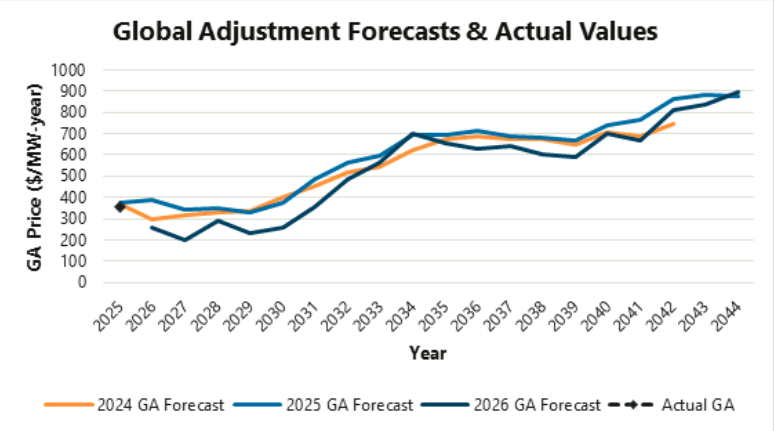
Reduced GA rates are unlikely to last. Peak Power’s energy markets team, drawing on IESO capacity planning data and current power purchase agreement (PPA) timelines, forecasts that GA rates will climb over the next several years — potentially returning to historical highs in the range of several hundred thousand dollars per megawatt-year, a level last seen during a prior peak in Ontario’s generation contracting cycle.
The market drivers behind this outlook are well known in the industry:
- Expiring supply contracts. Several gigawatts of generation capacity operate under power purchase agreements set to expire in 2029, including the 2.1 GW gas-fired Lennox Generating Station. Renewing or replacing this capacity will likely mean new contracts priced to reflect current construction, fuel, and operating costs, all of which flow into GA.
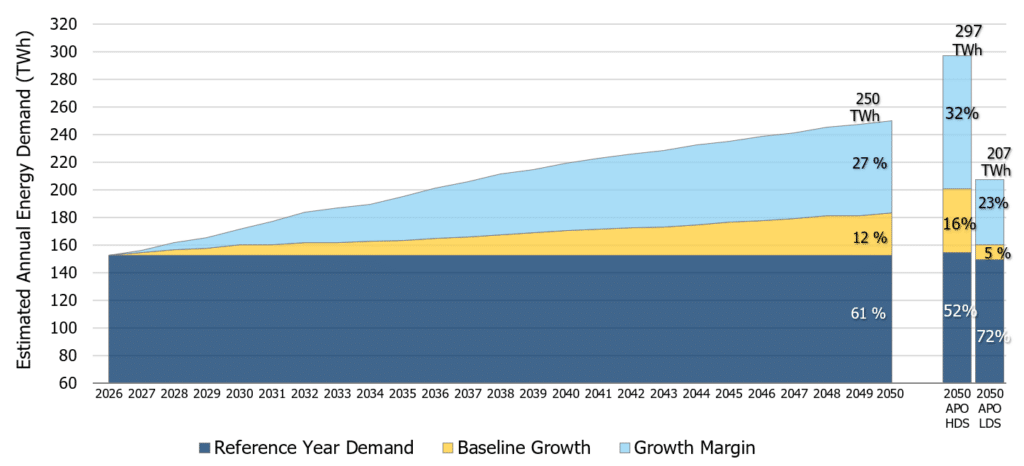
- Rising demand. The IESO’s long-term outlook projects Ontario’s net annual energy demand growing from roughly 152 terawatt-hours (TWh) today to approximately 250 TWh by 2050, driven by electrification, industrial expansion, data center growth, and population increases. This will require the build out of much more energy supplies in the province.
- Nuclear refurbishment and new build costs. Ontario is investing in small modular reactors (SMRs) at the Darlington Nuclear Generating Station, with current cost estimates around CAD 21 billion. As a first-of-its-kind deployment in Canada, that estimate carries meaningful uncertainty and could increase. Once online, recovery of these costs will likely flow through GA.
- Natural gas price exposure. Wholesale gas prices, a key input for Ontario’s gas-fired generation, remain sensitive to global supply disruptions. Global instability reflected by the Russia-Ukraine war and chokepoint at the Strait of Hormuz can disrupt gas supplies at any time. Gas prices are also affected by extreme weather, production and infrastructure constraints, and more.
The trendlines are clear. Electricity demand is expected to rise for many years to come, and Ontario is committed to procuring electricity that could add sizable cost recovery to GA rates. The graph below prepared by our markets team and supported by an independent third party, shows projected GA costs to rise to nearly $900/MW by 2044
How Businesses Can Reduce Global Adjustment Exposure
No matter how Ontario manages GA rates, the realities of grid modernization remain the same. Aging grid infrastructure will continue to get older, demand will continue to rise as we fully enter the AI age, and the need for better flexibility and grid utilization will continue to grow. Facilities that build in flexibility now will be better positioned as GA costs rise.
Behind-the-Meter (BTM) battery energy storage is one of the most direct tools available. Facilities that integrate distributed energy resources, particularly battery storage, can respond more quickly to changing electricity prices and grid conditions. Battery systems, paired with leading grid event forecasting, can be configured to automatically offset grid demand during a GA event, discharging stored energy instead of drawing from the grid during a forecasted GA event.
Timing matters here. Most energy infrastructure projects, including new generation, major retrofits, or interconnection upgrades, can stretch project timelines to seven years or more. BTM battery storage projects, by comparison, can typically be completed in 12 to 18 months, making them one of the fastest available responses to rising energy costs.
It’s also worth remembering that GA rates for Class A customers are determined using the prior year’s peak demand contribution. That means the value of any peak-management strategy — battery storage, curtailment planning, or demand forecasting — shows up on future bills, not immediately. Facilities aiming to control GA exposure in 2029, for example, should plan to have energy storage or demand-management systems in place well before then, since the base period used to calculate that year’s GA rate closes out roughly a year in advance.
Even during periods when GA rates are low or negative, as seen in early 2026, the businesses best positioned for the next rate cycle are the ones that keep investing in demand flexibility now rather than waiting for costs to climb again.
Frequently Asked Questions
What is Global Adjustment (GA) in Ontario? Global Adjustment is a charge applied to every Ontario electricity customer’s bill, covering the difference between the wholesale market price of electricity and the actual cost of contracted, regulated, and conservation-related generation resources across the province. It’s administered by the IESO. How it’s calculated, and whether it appears as its own line item on your utility bill, depends on your billing classification.
What’s the difference between Class A and Class B customers? Class A customers are large facilities that opt into the Industrial Conservation Initiative. This includes manufacturing and industrial businesses with average monthly peak demand between 500 kW and 1 MW, other medium consumers between 1 MW and 5 MW, and large consumers above 5 MW (who are automatically enrolled). They pay GA based on their contribution to Ontario’s five highest system-wide demand hours each year. Class B customers pay GA based on total monthly electricity consumption.
When do businesses need to opt in or out of Class A? Eligible medium-sized businesses that want to opt into Class A, and large consumers (above 5 MW) who’d prefer to opt out of their automatic Class A enrollment, must do so by June 15 each year. Eligibility is based on average monthly peak demand during the prior 12-month base period (May 1 to April 30).
Why did Ontario’s GA rate go negative in January 2026? Rising wholesale electricity prices driven by factors including a Pickering Nuclear Generating Station capacity shortfall, unseasonably cold weather, and regional grid demand, temporarily resulting in ratepayer credits rather than added charges.
Why are GA rates expected to rise in the coming years? Several gigawatts of generation contracts are set to expire in 2029, Ontario’s electricity demand is projected to grow substantially through 2050, and major nuclear investments (including new SMRs at Darlington) will eventually require cost recovery, all of which are expected to push GA rates higher.
Did Ontario’s Market Renewal Program change Global Adjustment? No. The Market Renewal Program (MRP), which launched May 1, 2025, overhauled how Ontario prices energy, replacing the province-wide HOEP with nodal Locational Marginal Pricing and a formal day-ahead market. Global Adjustment was not part of this reform and continues to be charged separately, using the same cost-recovery structure it always has.
How can businesses reduce their Global Adjustment costs? Class A-eligible facilities can actively manage consumption during anticipated system peak hours to lower their Peak Demand Factor. On-site battery energy storage is one of the most effective tools for this, since it can offset grid draw during GA events and can typically be deployed in 12–18 months. See our peak demand forecasting and battery storage solutions for more detail.